
Three parties share responsibility for Indian students abroad. The host university provides daily support and countries like Australia must legally offer orientation and a contact officer. Indian embassies and consulates handle registration, grievances and emergencies. Families and agents handle preparation before departure. India’s Ministry of External Affairs (MEA) reported 453 Indian student deportations from 2021 to 2025, mostly for visa breaches.
For students from Maharashtra, the same three parties apply, with one added gap: the MEA holds no state-wise data, so no Indian authority knows how many of the state’s students are at a given university. MahaEdu Trust’s analysis of MEA data finds that the university usually sees the earliest warning signs, such as poor attendance, unpaid fees and withdrawal.
Supporting students from Maharashtra? Our partnerships team can help you connect with the right contacts in Maharashtra. Contact the MahaEdu Trust team
Key Highlights
• Three parties share duty of care for Indian students abroad: the host university (daily support), Indian embassies and consulates (registration, grievances, emergencies) and families and agents (preparation before departure).
• The MEA counted 18,82,318 Indian students (1,882,318) in 153 countries as of 1 January 2025, but it holds no state-wise data, so there is no official count of students from Maharashtra.
• Indian embassies and consulates hold welcome ceremonies, visit universities and run 24x7 helplines, but registration is voluntary, so a mission may first hear of a student only after something has gone wrong.
• The MEA told the Lok Sabha in July 2024 that 633 Indian students had died abroad over five years across 41 countries, including 172 in Canada and 108 in the United States; 19 deaths were attributed to attacks.
• The MEA reported 453 Indian students deported in the five years to December 2025, led by the UK (170), Australia (114) and Russia (82); MahaEdu Trust’s analysis finds three of the six main reasons show up first in a university’s own records.
AI-Generated Summary
Responsibility for Indian students abroad is shared by the host university, Indian embassies and consulates, and the families and agents who prepare students before departure. Universities carry daily support and, in Australia, must meet National Code Standard 6. Indian missions offer voluntary registration, the MADAD grievance portal, 24x7 helplines and crisis help. MEA data shows 633 Indian student deaths abroad in five years to July 2024, mostly from natural causes, accidents and medical conditions, and 453 deportations in five years to December 2025, mostly for visa breaches. Poor attendance, unpaid fees and withdrawal, three of the six main deportation reasons, are visible to universities first.
A composite example (illustrative, not a real case). It is week four of term. A master’s student from Nagpur has missed six lectures, and the attendance system has logged every one. A fee instalment is overdue. The agent who placed her is busy with next year’s applicants. Her parents believe all is well. The Indian consulate does not know she exists, because she never registered. Nobody has done anything wrong. Everyone assumed someone else was watching.
Duty of care works like a relay: the family, counsellor and agent carry the student to the start line, the university takes over on campus, and the Indian mission is the safety net beside the track. The baton is rarely dropped mid-stride. It is dropped at the handovers. This guide is written for international offices and student services teams at universities abroad, and for officials in India concerned with student welfare.
Who Is Responsible for What, Before and After Arrival?
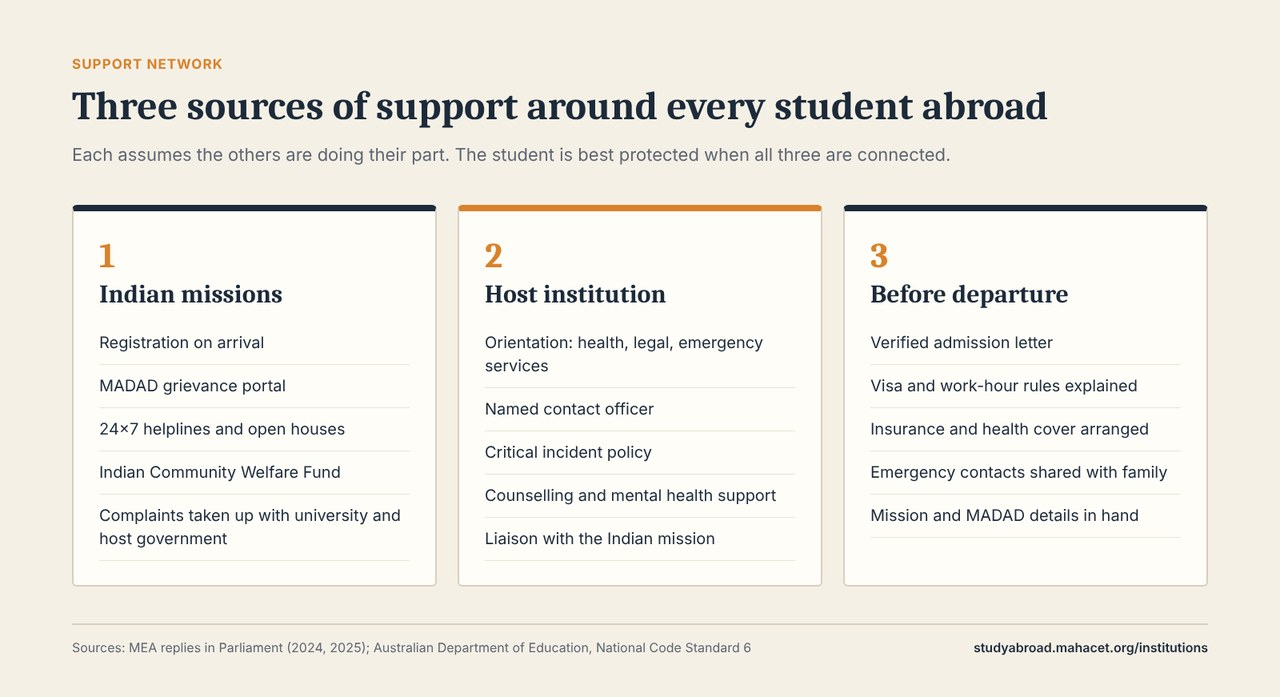
Before departure, families, counsellors and agents lead, with the university supplying documents and rules. On arrival and during study, the host university leads, with the Indian embassy or consulate as a voluntary safety net. In an emergency, all three act: the university under its critical incident policy, the mission through consular help, and the family as first contact.
This breakdown is MahaEdu Trust’s summary of the roles described in MEA statements to Parliament and Australia’s National Code. Items marked “legal minimum in Australia” are duties under National Code Standard 6; the rest are typical practice.
Before departure
• Host university: Sends the offer letter, enrolment steps, visa conditions and work rules directly to the student; verifies academic records at source.
• Indian embassy or consulate: Publishes student advisories; the MEA Students Registration Portal is open for registration.
• Family, counsellor or agent: Checks the admission letter is genuine, plans the full cost and keeps the required funds in place.
On arrival
• Host university: Runs orientation and names a contact officer (legal minimum in Australia).
• Indian embassy or consulate: Holds welcome ceremonies and orientation for new Indian students.
• Family, counsellor or agent: Makes sure the student registers with the mission and on MADAD.
During study
• Host university: Provides wellbeing services and support staff (legal minimum in Australia); monitors attendance and fees.
• Indian embassy or consulate: Runs 24x7 helplines, open houses and the MADAD portal; visits universities to meet students.
• Family, counsellor or agent: Stays in touch and knows whom to call at the university.
In an emergency
• Host university: Follows its critical incident policy (legal minimum in Australia) and contacts family within privacy rules.
• Indian embassy or consulate: Takes complaints up with the university or host government; provides help such as food, shelter, medicine and evacuation in crises.
• Family, counsellor or agent: Contacts the mission or files on MADAD.
The risk sits in the gaps between these roles, when each party assumes another has acted.
How Many Indian Students Study Abroad, and How Many Are From Maharashtra?
The MEA counted 18,82,318 Indian students (1,882,318) in 153 countries as of 1 January 2025, according to data tabled in the Rajya Sabha on 4 December 2025. Of these, 12,54,013 (1,254,013) were in universities and other tertiary institutions and 6,28,305 (628,305) were in schools. The MEA holds no state-wise data, so there is no official count for Maharashtra.
The MEA repeated these figures in February 2026. The PIE News, reporting the December 2025 data, noted that university-level enrolments abroad from India dropped after three years of growth.
The MEA told the Lok Sabha in August 2024 that it holds no state-wise data on Indian students abroad. The best available proxy is passport-linked data for 2020, compiled by NITI Aayog, which placed Maharashtra third among Indian source states. That proxy is six years old.
Worth knowing: With no state register, neither Maharashtra’s authorities nor Indian missions can easily see how many of the state’s students are in a given city or university. A university’s own enrolment records may hold a clearer picture of its Maharashtra students than any Indian government dataset.
How Do Indian Embassies and Consulates Support Students Abroad?
Indian embassies and consulates (together called Indian missions) support students through welcome ceremonies, orientation on risks, university visits, advisories, voluntary registration, the MADAD grievance portal and 24x7 helplines, according to the MEA’s July 2024 statement to the Lok Sabha. Missions also take student complaints up with universities and host governments, and help with evacuation in emergencies.
• Welcome and orientation: Missions keep in contact with Indian students from enrolment, starting with welcome ceremonies. Heads of mission run orientation on likely challenges and threats, and on what students can do about them.
• University visits: Heads of mission and senior officials visit universities to meet Indian students and Indian Students’ Associations. According to the MEA’s December 2025 reply, reported by The PIE News, these visits also assess the credibility and quality of the courses students are taking.
• Advisories: Missions issue formal student advisories. The MEA’s December 2025 reply lists examples, including guidelines from India’s missions in the United States on what students should take care of before and after arrival.
• Registration and MADAD: Students are encouraged to register through the MEA Students Registration Portal and on the MADAD portal, so grievances can be resolved within set timelines. Registration is voluntary.
• Helplines and outreach: 24x7 emergency helplines, open houses, walk-ins, telephone, email and social media.
• Indian Community Welfare Fund (ICWF): Emergency medical help, temporary accommodation and other support for Indians in distress, including students, as reported by Business Standard in February 2026.
• Crisis support: In emergencies, missions provide food, shelter and medicine and help with return or evacuation, as in the Vande Bharat Mission, Operation Ganga (Ukraine) and Operation Ajay (Israel).
• Complaints: Student complaints are taken up with the university and, where needed, the host government.
How Can Universities Work With the Indian Mission?
Universities can connect their own welcome and support activities to the Indian mission’s, because missions already run welcome ceremonies and university visits. MahaEdu Trust recommends four steps: invite the mission to welcome week, add its student advisories and the MADAD link to the pre-arrival pack, agree a named consular contact for serious incidents, and introduce the mission to the Indian Students’ Association.
Mission support is real, but a student who never registers and never calls falls past it. The university is often the only party that can make the introduction in week one.
What Must Universities Provide for International Students in Australia?
In Australia, Standard 6 of the National Code of Practice for Providers of Education and Training to Overseas Students 2018 requires every registered provider to run an orientation programme, name at least one official contact officer, keep a documented critical incident policy and employ enough support staff for its overseas students. A 24-hour contact officer is allowed but not required.
• Orientation programme: Must cover support services, legal, emergency and health services, complaints and appeals, attendance and progress rules, employment rights (with resources such as the Fair Work Ombudsman), and safety information, including how to report an incident.
• Official point of contact: At least one contact officer, with up-to-date details of support services.
• Critical incident policy: Documented procedures for a traumatic event, or the threat of one, that causes extreme stress, fear or injury, with records kept for at least two years.
• Support staff: Enough student support personnel for the number and needs of overseas students.
Two of the orientation items, attendance rules and employment rights, match two of the main deportation reasons in MEA data.
Rule checked 21 November 2026: the National Code 2018 is in force, with a compilation dated October 2026 and a scheduled repeal date of 1 October 2027. Check the current version before relying on it. This guide covers Australia only; other destinations set their own rules, and Standard 6 makes a useful benchmark.
Why Are Indian Students Deported?
Indian students are deported mainly for breaching visa rules, according to the MEA’s 4 December 2025 reply to the Rajya Sabha. The reasons listed were unauthorised work or business, breaking host-country laws, failing to keep required funds, unpaid university fees, poor attendance, and withdrawing from the programme. The MEA reported 453 Indian students deported over five years.
Indian students deported in the five years to December 2025, by country (MEA annexure; The PIE News; Free Press Journal):
• United Kingdom: 170
• Australia: 114
• Russia: 82
• United States: 45
• Georgia: 17
• Ukraine: 13
• Other countries (Finland, China, Egypt, Austria): 12
Business Standard has also reported fraudulent admission letters among the reasons Indian students face deportation.
Which Deportation Warning Signs Can Universities See First?
Three of the six main reasons for deporting Indian students, poor attendance, unpaid fees and withdrawal from the programme, appear in a university’s own records before they reach an immigration officer. This is MahaEdu Trust’s analysis of the MEA’s December 2025 list; the MEA does not say how many cases fall under each reason.
• Poor attendance: Seen first by the academic department. Reach out at the first pattern of absence, before it becomes a visa report.
• Unpaid fees: Seen first by the finance office. Offer a hardship conversation or payment plan, and explain the visa link.
• Withdrawing from the programme: Seen first by the registry. Explain visa consequences before the withdrawal is processed.
• Not keeping required funds: Usually visible only to the student and family. Give realistic total-cost figures before departure.
• Unauthorised work or business: Often seen by no one until it is too late. Explain work-hour limits at orientation, in writing, directly to the student.
• Breaking host-country laws: Seen by local authorities. Cover legal rights and local rules at orientation.
Some deportation cases start years before arrival. In Canada, a travel agent from Jalandhar pleaded guilty to supplying fake acceptance letters for Canadian colleges and universities between 2016 and 2020. CBC reported that dozens of students were duped, and many faced removal orders. They had done what they were told. What they were told was false.
Why Are Indian Students Denied Entry at the Border?
Indian students are denied entry mainly because of problems with admission paperwork, according to the MEA’s 4 December 2025 reply to the Rajya Sabha. Students were turned away for carrying incomplete or inappropriate admission documents, not completing enrolment steps, or being unable to answer basic questions about their course. The United States denied entry to 62 Indian students and Kyrgyzstan to 11 over five years.
All three reasons can be reduced by the university. Admissions teams can send final documents and enrolment steps directly to the student, and give every admitted student a short course summary they can explain in their own words.
Worth knowing: A student cannot keep to rules they were never clearly told. Pre-departure information from the university itself, not only from an agent, is one of the simplest forms of protection.
What Should Universities Send Students Before Departure?
Universities should send every admitted student a short pre-departure pack directly, not only through an agent. MahaEdu Trust recommends nine items, built from the reasons for deportation and denied entry in the MEA’s December 2025 reply: admission documents, a course summary, visa conditions, attendance rules, fee dates, required funds, support contacts, Indian mission details and a family contact route.
• Offer letter and enrolment steps: The final admission documents, plus every step the student must complete to enrol.
• A one-paragraph course summary: Programme name, length, campus and start date, so the student can answer basic questions at the border.
• Visa conditions in plain words: Work-hour limits and what counts as unauthorised work, with a link to the official government page.
• Attendance and progress rules: The minimum attendance, and what happens if the student falls behind.
• Fee schedule: Due dates, and whom to call before a payment is missed.
• Funds to hold: The bank balance or proof of funds the visa requires, and for how long.
• Support contacts: The contact officer, the emergency number and how to reach wellbeing services.
• The Indian mission: Its contact details and student advisories, the Students Registration Portal and the MADAD link.
• A route for family: How parents in Maharashtra can raise a concern, within the university’s privacy rules.
Send the pack to the student’s own email address, and resend the key points in the first week on campus.
Where Are the Gaps in Support for Indian Students Abroad?
The five main gaps in support for Indian students abroad are the lack of state-level data, voluntary mission registration, information that reaches students only through agents, uneven legal duties of care across countries, and families with no direct contact at the university. Each gap sits at a handover between the family, the university and the Indian mission.
• No state-level picture: Without state-wise data, Maharashtra cannot see where its students are or what problems they face.
• Voluntary registration: Indian missions cannot help students they do not know about.
• Agent-filtered information: When documents and rules reach students only through agents, errors and fraud can go unnoticed.
• Uneven host obligations: Legal duties of care differ by country.
• Families far away: Parents in Maharashtra often have no direct contact at the university and no clear route to raise a concern.
None of these gaps needs new law to narrow. Every one narrows with a direct line of communication.
What Can Universities Do to Support Students From Maharashtra?
Universities can support students from Maharashtra with seven practical steps: send the pre-departure pack directly, verify admissions at source, run a thorough orientation, bring the Indian mission into week one, turn attendance and fee alerts into conversations, make wellbeing services visible, and name contacts for families and the mission. None requires new budget lines or new law.
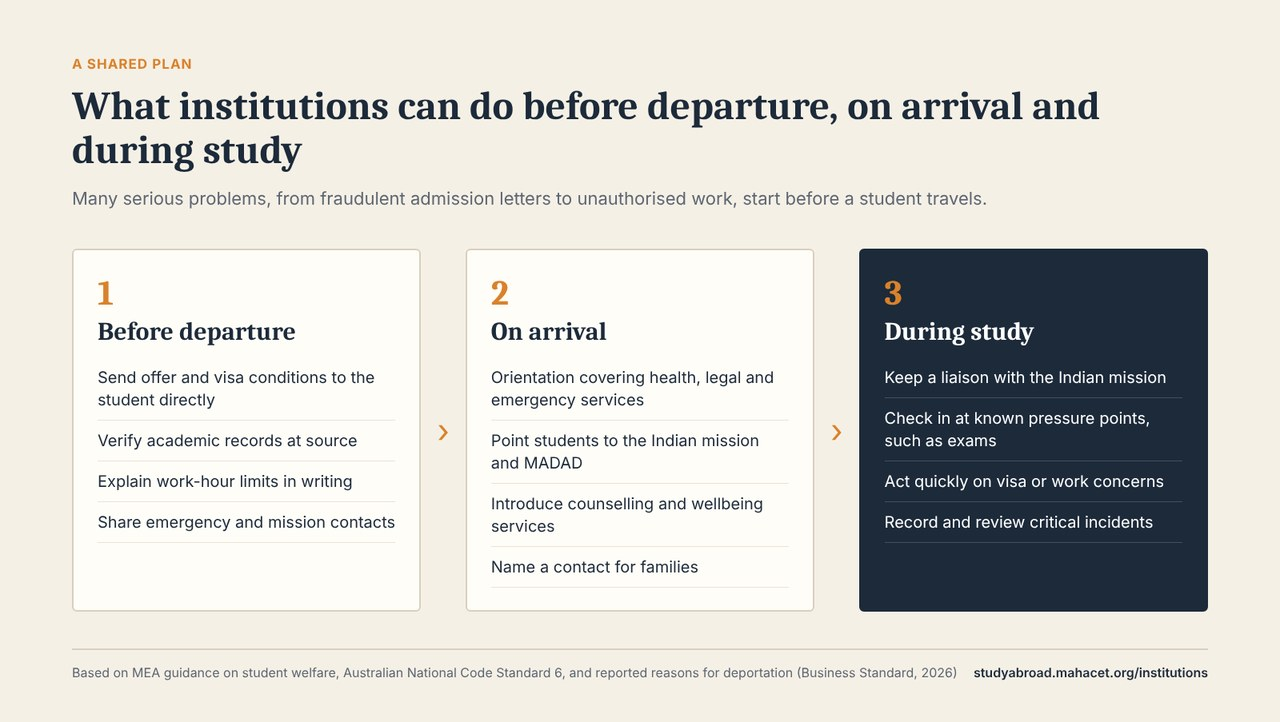
1. Send the pre-departure pack directly: Offer letters, visa conditions, work-hour rules, fee dates and the course summary go to the student, not only to the agent.
2. Verify admissions at source: Confirm academic records with the issuing body so that students arrive on genuine documents. MahaEdu Trust’s guide to verifying academic credentials from Maharashtra explains how.
3. Run a thorough orientation: Cover health care and insurance, emergency contacts, legal rights, work rules, attendance rules, housing and how to report a problem.
4. Bring the Indian mission into week one: Invite it to welcome events, and show students the Students Registration Portal and MADAD during orientation.
5. Turn attendance and fee alerts into conversations: Treat a missed class or an unpaid fee as a reason to talk, not only a reason to report.
6. Make wellbeing services visible: Counselling and mental health support should be easy to find and culturally aware.
7. Name a contact for families, and one for the mission: Give families a route to raise concerns within privacy rules, and keep a named liaison with the Indian mission.
Worth knowing: Ask three questions of your Maharashtra intake. Does every student get their offer letter and visa conditions from you, not only from an agent? Does a missed-attendance or unpaid-fee flag trigger a conversation before it triggers a report? Does every family know one name to call? If any answer is no, that is your first fix.
Go back to the composite student from Nagpur. With step 5 in place, her missed lectures start a conversation in week two. With step 4, the consulate has her details. With step 7, her parents know whom to call. Same student, same pressures, but this time somebody is watching.
What This Means for Government Officials
For Maharashtra, three steps would close part of the gap without new legislation: pre-departure guidance for students and families, especially on checking admission letters and understanding visa conditions; closer contact with students funded through state overseas scholarship schemes, whose destinations are already known; and channels for sharing emerging risks with host institutions and Indian missions.
Key Terms Explained
• MEA: India’s Ministry of External Affairs, which runs India’s embassies and consulates and reports student data to Parliament.
• Indian mission: An Indian embassy, high commission or consulate abroad. The MEA also calls these “missions and posts”.
• MADAD: The MEA’s online grievance portal for Indians abroad, including students, at madad.gov.in.
• Indian Community Welfare Fund (ICWF): A fund used by Indian missions for emergency help to Indians in distress, including medical help and temporary accommodation.
• Lok Sabha and Rajya Sabha: The lower and upper houses of India’s Parliament. MEA figures in this guide come from written replies to questions in both.
• Lakh: An Indian number unit equal to 100,000. 18.8 lakh is about 1.88 million.
• Deported vs denied entry: A deported student is removed after entering the country; a student denied entry is refused at the border.
• National Code 2018, Standard 6: The Australian legal standard setting minimum support services that registered providers must offer overseas students.
• Critical incident: Under Australia’s National Code, a traumatic event, or the threat of one, that causes extreme stress, fear or injury.
What We Do Not Know Yet
There is no official data on Maharashtra students abroad by country or institution, on how many register with Indian missions, or on outcomes such as completion rates. National figures on deaths and deportations describe all Indian students, are reported only periodically through Parliament, use different time periods, and do not break down deportation reasons by number. Institutions should treat these figures as context, not as a measure of risk at any single university.
A Note on Planning
Duty of care is a relay between India’s missions, host institutions and the people who prepare students to leave, and most avoidable problems happen at the handovers. Verified admissions, honest counselling, a direct pre-departure pack and an early introduction to the Indian mission matter as much as support on campus.
Students can explore destinations on the country comparison, browse fields under programs, and follow policy changes on MahaEdu Trust news. What this portal does and does not undertake is set out in its Honesty Promise.
How this guide was made: This guide was prepared by MahaEdu Trust (studyabroad.mahacet.org). Information comes from Ministry of External Affairs statements and data tabled in Parliament (July 2024, December 2025 and February 2026), the MEA Students Registration Portal, the Australian Department of Education’s guidance on National Code Standard 6 and the Federal Register of Legislation. Figures from the MEA’s December 2025 annexures were cross-checked against reporting by The PIE News and Free Press Journal; other reporting comes from Business Standard, Careers360 and CBC News. Sections marked as MahaEdu Trust analysis or recommendations are our interpretation, not official data. We present official figures as reported, without extrapolation, and note where time periods differ. Sources last checked 21 November 2026. This guide is reviewed as new official data is released.
Official Sources
Every figure in this article traces to the sources below. Rules and statistics change, so open the source before acting on it.
Government and regulator sources
• Ministry of External Affairs, Rajya Sabha written reply of 4 December 2025, annexure: Data on Indian Students Abroad (as on 1 January 2025) https://www.mea.gov.in/Images/CPV/557-en-01-04-12-2025.pdf
• Ministry of External Affairs, Rajya Sabha written reply of 4 December 2025, annexure: Indian students deported or denied entry during the last five years https://www.mea.gov.in/Images/CPV/557-en-02-04-12-2025.pdf
• Ministry of External Affairs, Rajya Sabha written reply of 4 December 2025, annexure: advisories issued by Indian missions for students https://www.mea.gov.in/Images/CPV/557-en-03-04-12-2025.pdf
• Ministry of External Affairs, Data on Indian Students Abroad (as on January 2025), Rajya Sabha, February 2026 https://www.mea.gov.in/images/CPV/RS-75-02-05-02-2026-en.pdf
• Ministry of External Affairs, Lok Sabha Question 4166, Indian students going abroad for higher studies (August 2024) https://www.mea.gov.in/lok-sabha.htm?dtl/38840/QUESTION_NO_4166_INDIAN_STUDENTS_GOING_ABROAD_FOR_HIGHER_STUDIES
• Lok Sabha Starred Question 75, Attacks on Indian Students (26 July 2024) https://eparlib.nic.in/bitstream/123456789/2980974/1/AS75_NsOdMM.pdf
• Lok Sabha Starred Question 19, Safety of Indian Students Abroad (2 February 2024) https://eparlib.nic.in/bitstream/123456789/2973773/1/AS19.pdf
• Ministry of External Affairs, Students Registration Portal https://www.mea.gov.in/Students-Registration-Portal
• Ministry of External Affairs, MADAD portal https://madad.gov.in
• NITI Aayog, Working Paper on International Student Mobility https://www.niti.gov.in/sites/default/files/2025-11/Working_Paper_International_Student_Mobility_Final.pdf
• Australian Department of Education, Standard 6: Overseas student support services https://education.gov.au/download/11458/standard-6-overseas-student-support-services/29920/document/pdf
• Federal Register of Legislation, National Code of Practice for Providers of Education and Training to Overseas Students 2018 https://www.legislation.gov.au/F2017L01182/latest/details
Supporting sources (non-government)
• The PIE News, UK, Australia and Russia top Indian student deportations: MEA data (23 December 2025) https://thepienews.com/uk-australia-and-russia-top-indian-student-deportations-mea-data/
• Free Press Journal, Over 18.8 lakh Indian students abroad; MEA flags deportations (December 2025) https://www.freepressjournal.in/education/over-188-lakh-indian-students-abroad-mea-flags-deportations-ramps-up-safety-measures
• Business Standard, Indian student crisis: 26 killed in Canada and US; deportations on the rise (9 February 2026) https://www.business-standard.com/immigration/indian-student-crisis-26-killed-in-canada-and-us-deportations-on-the-rise-126020900289_1.html
• Careers360, 633 Indians died abroad in past five years, says MEA (July 2024) https://news.careers360.com/study-abroad-633-indians-died-abroad-in-past-5-years-most-in-canada-says-mea
• CBC News, Man pleads guilty in international students fraud case https://www.cbc.ca/1.7218773
Frequently Asked Questions
Who is responsible for the safety of Indian students abroad?
Three parties share it. The host university provides daily support and, in countries such as Australia, must meet legal minimums. Indian embassies and consulates handle registration, grievances through MADAD, 24x7 helplines and emergencies. Families, counsellors and agents handle preparation before departure. Problems most often arise at the handovers between them.
How many Indian students study abroad?
The Ministry of External Affairs counted 18,82,318 Indian students (about 1.88 million) in 153 countries as of 1 January 2025, according to data tabled in the Rajya Sabha in December 2025. Of these, 12,54,013 were in universities and other tertiary institutions, and 6,28,305 were in schools abroad.
Does India track how many students go abroad from each state?
No. The MEA told the Lok Sabha in August 2024 that it holds no state-wise data on Indian students abroad. The best available proxy is 2020 passport-linked data compiled by NITI Aayog, which placed Maharashtra third among Indian source states. There is no current official count for Maharashtra.
What is the MADAD portal?
MADAD is the Ministry of External Affairs’ online grievance portal for Indians abroad, including students, at madad.gov.in. A student or family can use it to raise a problem with the Indian embassy or consulate, and the MEA says grievances are resolved within set timelines. Missions also run 24x7 helplines and open houses.
Should Indian students register with the Indian embassy?
Yes. The MEA encourages Indian students abroad to register with their embassy or consulate and on MADAD, although registration is voluntary. A mission can act faster for a student it already knows about. Universities can help by showing the MEA Students Registration Portal and MADAD during orientation in the first week.
Do Indian embassies work with foreign universities?
Yes. According to the MEA’s July 2024 statement to the Lok Sabha, Indian heads of mission and senior officials visit universities to meet Indian students and student associations, and missions hold welcome ceremonies for new students. Student complaints are taken up with the university and, where needed, the host government.
Why are Indian students deported?
According to the MEA’s December 2025 reply to the Rajya Sabha, the main reasons are unauthorised work or business, breaking host-country laws, failing to keep required funds, unpaid university fees, poor attendance and withdrawing from the programme. The MEA reported 453 Indian students deported in five years, most from the UK (170), Australia (114) and Russia (82).