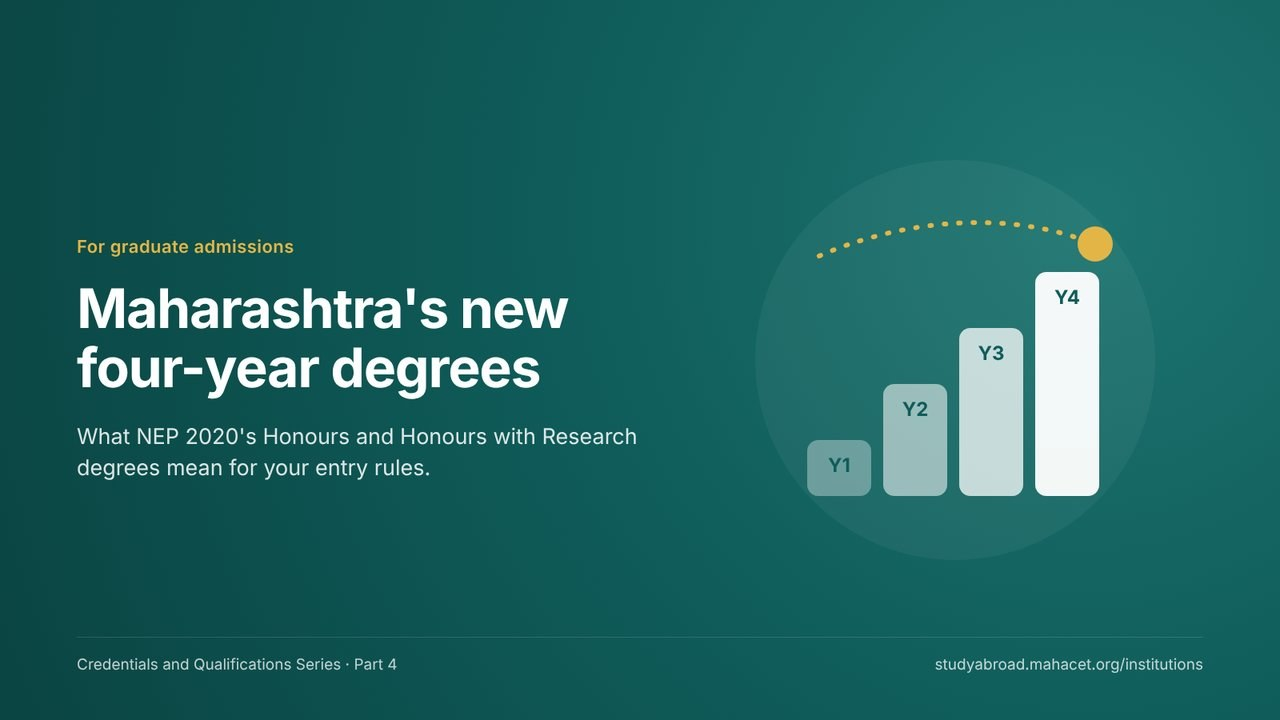
From the 2026-27 academic year, every public university in Maharashtra, with its affiliated and autonomous colleges, offers four-year bachelor's degrees with Honours or Honours with Research, alongside the familiar three-year degree. A four-year Honours degree carries 160 to 176 credits; a three-year degree carries 120 to 132. For graduate admissions abroad, that means two kinds of Maharashtra bachelor's degree will arrive side by side for years, and the credit total, not the degree name, tells them apart.
Updating your entry requirements? Our partnership team can brief you on how Maharashtra's four-year degrees are structured and when the first graduates arrive. Contact the Maha Study Abroad team
Key Highlights
• A Government of Maharashtra resolution, reported on 7 April 2026, introduced four-year Honours and Honours with Research degrees across all public universities and their colleges from 2026-27.
• Four-year Honours degrees require 160 to 176 credits including a final-year internship; Honours with Research adds a 12-credit research project or dissertation in the major subject.
• Maharashtra sets a minimum CGPA of 7.5 for the research track, and research places are limited by the number of recognised PhD guides, up to five students each.
• Students can still leave with a three-year degree after 120 to 132 credits, so three-year and four-year graduates will coexist for several admission cycles.
• Engineering degrees approved by AICTE were already four years long; the change matters most for arts, science and commerce graduates.
AI-Generated Summary
Maharashtra has moved from a phased NEP 2020 rollout to a statewide four-year undergraduate structure from 2026-27. Students now choose after three years between leaving with a bachelor's degree, continuing to an Honours degree, or, with a CGPA of 7.5 or more, taking Honours with Research. For graduate admissions abroad, the practical tests are the credit total, the award title and whether the fourth year was completed. Institutions that review their three-year degree policies now will be ready when the first four-year graduates apply.
For most of the last century, a bachelor's degree in arts, science or commerce from a Maharashtra university meant three years of study. Graduate schools abroad built their entry rules around that fact, and many treated the three-year degree as one year short of their own four-year standard.
That is changing. India's National Education Policy 2020 introduced a four-year undergraduate degree, and Maharashtra has now made it available across its entire public university system. This guide is written for graduate admissions officers and credential evaluators. It explains the national framework, how Maharashtra has implemented it, how to read the new degrees, and what to review in your own entry rules. Where implementation is uneven or results are not yet in, we say so.
The National Framework
The University Grants Commission set out the structure in its Curriculum and Credit Framework for Undergraduate Programmes, issued on 12 December 2022. It defines three main pathways and two earlier exit points:
• UG Certificate: 40 credits after one year, plus a 4-credit vocational course in the summer.
• UG Diploma: 80 credits after two years, plus a further 4-credit vocational course.
• Three-year bachelor's degree: 120 credits, or 132 for a double major.
• Four-year bachelor's degree (Honours): At least 160 credits.
• Four-year bachelor's degree (Honours with Research): At least 160 credits, including 12 credits from a research project or dissertation.
The framework sets a minimum of 20 credits per semester. The UGC's companion framework for postgraduate programmes links the two levels: a one-year master's is designed to follow a four-year Honours degree, while a two-year master's follows a three-year degree.
How Maharashtra Implemented It
Maharashtra phased the change in over three years.
• 2023-24: Autonomous colleges and university departments began NEP programmes. The state had 144 autonomous institutions at the start.
• 2024-25: The new structure extended to affiliated colleges. The University of Mumbai alone applied it to 874 affiliated institutes.
• April 2026: A Government Resolution from the Higher and Technical Education Department introduced four-year Honours and Honours with Research degrees across all public universities and their affiliated and autonomous colleges from 2026-27.
• May and June 2026: The state made training on the new structure mandatory for college principals, directors and faculty, delivered online through the Maharashtra State Faculty Development Academy.
• October 2026: The Higher and Technical Education Minister directed all public universities to adopt a common academic calendar from 2026-27 and called for a uniform statewide policy on re-examinations and ATKT.
What the April 2026 resolution requires
• Credits: 160 to 176 credits over eight semesters for a four-year Honours degree, including an internship in the final year.
• Entry to the fourth year: 120 to 132 credits completed in the first three years.
• Honours with Research: A 12-credit research project or dissertation in the major subject, open to students with a minimum CGPA of 7.5.
• Research places: Limited by the number of recognised PhD guides, with up to five students per guide.
• Academic Bank of Credits: Registration is mandatory for all students, to support credit transfer, exit and re-entry.
• Lateral entry: Students may join the fourth year at another college or department, subject to eligibility, seats and the state's reservation policy.
• Online study: Up to 40 per cent of a semester's courses may be taken through SWAYAM, in line with UGC rules.
• Link to master's study: The Honours year is aligned with the first year of a two-year master's programme.
Worth knowing: Maharashtra's research-track threshold is a CGPA of 7.5. The UGC framework uses 75 per cent marks in the first six semesters. An evaluator reading a Maharashtra Honours with Research degree can assume the student met the state's own threshold, not necessarily the UGC figure.
Not Every College Will Offer the Fourth Year
The resolution does not make the fourth year automatic everywhere. Colleges that already teach postgraduate courses in the same subject can add the Honours year directly, and those with recognised PhD research centres can offer Honours with Research without further approval. Other colleges need permission to add a fourth year.
In practice, the fourth year will be most widely available at larger, established colleges and university departments. A student at a smaller college may complete three years and then either leave with a bachelor's degree or move to another institution for the fourth year through lateral entry.
Engineering Is Different
Engineering degrees approved by the All India Council for Technical Education, such as the B.E. and B.Tech, were already four-year programmes, and the April 2026 resolution notes a separate framework for them, with options such as a minor, a double minor or Honours. The change described in this guide affects mainly arts, science and commerce. An evaluator who has long accepted Maharashtra engineering graduates for master's study does not need to change anything for them.
How to Read the New Degrees
1. Check the credit total: 160 or more credits indicates a four-year degree; 120 to 132 indicates a three-year degree.
2. Check the award title: Honours and Honours with Research are four-year awards. A degree without either title, from the same university, is usually the three-year award.
3. Look for the research component: Honours with Research should show a 12-credit project or dissertation in the major subject.
4. Do not treat exit awards as degrees: UG Certificates and UG Diplomas are partial completions after one or two years.
5. Read the semester record: A four-year transcript should show eight semesters and a final-year internship.
6. Check the Academic Bank of Credits where relevant: For students who transferred or re-entered, credits may come from more than one institution.
What This Means for Graduate Admissions
Many graduate schools, particularly in the United States and Canada, have treated a three-year Indian bachelor's degree as one year short, unless it met conditions such as First Division from a NAAC "A" accredited institution under the WES standard. A four-year Honours degree with 160 or more credits is designed to remove that gap.
Each institution decides for itself how to recognise the new degrees, and credential evaluators are still adjusting. Some practical steps help:
• Review your three-year policy now: Decide whether a four-year Honours degree meets your four-year bachelor's requirement, and publish the rule.
• Avoid penalising three-year graduates: Three-year degrees remain valid and common, and many strong applicants will continue to hold them.
• Consider the research track: An Honours with Research graduate has completed supervised research in the major subject, which may be relevant for research master's and doctoral admissions.
• Plan for mixed cohorts: Expect applicants with both kinds of degree from the same university, often in the same year.
Rollout Has Been Uneven
The move to four-year degrees has not been smooth everywhere. Maharashtra formed a special task force to speed up NEP implementation after difficulties with credit transfer and with entry and exit options. At least one student at St Xavier's College, Mumbai, has reported a planned fourth year being withdrawn. The state's mandatory training programme and its October 2026 push for a common academic calendar both reflect efforts to make implementation consistent across universities.
What We Do Not Know Yet
The first cohorts to complete a four-year Honours degree across Maharashtra's public universities have not yet graduated, so there is no evidence yet on how many students choose the fourth year, how many complete Honours with Research, or how graduate schools and credential evaluators abroad will treat the new degrees in practice. On the current timetable, students who began under NEP in 2023-24 would reach the fourth year in 2026-27. Institutions should expect the picture to become clearer over the next two or three admission cycles.
A Note on Planning
Three-year and four-year Maharashtra graduates will coexist for several admission cycles. Checking credit totals, award titles and the research component, rather than the degree name alone, lets admissions teams recognise the new four-year Honours degrees without disadvantaging three-year graduates. Reviewing entry rules before the first cohorts apply avoids decisions made case by case under deadline pressure.
Students can explore destinations on the country comparison, browse fields under programs, and follow policy changes on Maha Study Abroad news. What this portal does and does not undertake is set out in its Honesty Promise.
How this guide was made: Information comes from the UGC's 2022 undergraduate and postgraduate credit frameworks as published and reported, the Government of Maharashtra's April 2026 resolution as reported by PTI and ThePrint, and reporting by Careers360, Free Press Journal and The Quint. The first statewide cohorts have not yet graduated, and we say so rather than predict outcomes. This guide is reviewed as the rollout progresses.
Official Sources
Every figure in this article traces to the sources below. Rules and statistics change, so open the source before acting on it.
Government and regulator sources
• UGC, Curriculum and Credit Framework for Postgraduate Programmes (as published by MITS) https://mits.ac.in/assets/pdf/iqac/Curriculum-and-Credit-Framework-for-Postgraduate-Programmes.pdf
Supporting sources (non-government)
• ThePrint (PTI), Maharashtra to introduce four-year UG programmes with honours, research degrees (April 2026) https://theprint.in/india/maharashtra-to-introduce-4-year-ug-programmes-with-honours-research-degrees/2898439
• ThePrint (PTI), NEP rollout: training made mandatory for principals and faculty of Maharashtra colleges (April 2026) https://theprint.in/india/nep-rollout-training-made-mandatory-for-principals-faculty-of-maharashtra-colleges/2907663/
• Careers360, Maharashtra universities to adopt common academic calendar from 2026-27 (October 2026) https://news.careers360.com/maharashtra-universities-adopt-common-academic-calendar-from-2026-27-atkt-rules-in-focus
• GKToday, UGC four-year undergraduate programmes https://www.gktoday.in/ugc-four-year-undergraduation-programme/
• ETV Bharat, UGC notifies curriculum and credit framework for undergraduate courses under NEP https://etvbharat.com/english/state/delhi/ugc-notifies-curriculum-credit-framework-for-undergraduate-courses-under-nep/na20221212230917064064192
• Careers360, 144 autonomous institutions in Maharashtra start NEP implementation https://news.careers360.com/144-autonomous-institutions-in-maha-start-nep-implementation-academic-year-minister/amp
• Free Press Journal, MU introduces four-year UG courses for non-autonomous colleges https://www.freepressjournal.in/amp/education/mu-introduces-four-year-ug-courses-for-non-autonomous-colleges
• Free Press Journal, Maharashtra forms special task force to fast-track NEP 2020 rollout https://www.freepressjournal.in/education/maharashtra-forms-special-task-force-to-fast-track-nep-2020-rollout-in-colleges-universities
• The Quint, St Xavier's Mumbai student on a scrapped fourth year https://www.thequint.com/amp/story/my-report/st-xaviers-mumbai-student-fourth-year-scrapped-gap-year
• WES, How WES evaluates three-year Indian bachelor's degrees https://www.wes.org/resource-library/blog/credential-advice/3-year-indian-bachelors-degree/
Frequently Asked Questions
Are all Maharashtra bachelor's degrees now four years long?
No. Students can still leave with a three-year bachelor's degree after 120 to 132 credits, and many will. The four-year Honours degree is an additional option from 2026-27.
How can an evaluator tell a three-year degree from a four-year degree?
By the credit total and the award title. A four-year Honours degree carries 160 to 176 credits and the title Honours or Honours with Research; a three-year degree carries 120 to 132 credits.
Who can take Honours with Research in Maharashtra?
Students with a minimum CGPA of 7.5 after three years, subject to the availability of recognised PhD guides, with up to five students per guide. The track includes a 12-credit research project or dissertation.
Does a four-year Honours degree meet four-year bachelor's requirements abroad?
It is designed as a four-year degree of at least 160 credits, but each institution and credential evaluator decides how to recognise it. Confirm and publish your own rule.
Are UG Certificates and Diplomas degrees?
No. They are exit awards after one or two years of study, not completed bachelor's degrees.
Does this change affect engineering graduates?
Little. AICTE-approved engineering degrees such as the B.E. and B.Tech were already four years long and follow a separate framework. The change matters mainly for arts, science and commerce.