

Since 2022, eligible Indian and foreign universities have been able to offer twinning, joint and dual degree programmes without prior approval from the University Grants Commission. The rules are now flexible, but the results so far are modest: a NITI Aayog survey found that only about one in ten formal agreements between Indian and foreign institutions includes plans for a joint degree, and only half of universities say their collaborative programmes have worked. Partnerships that succeed tend to start small and build trust over several years.
Exploring a degree partnership? Our partnership team can help you identify eligible Maharashtra universities and realistic first steps.
Key Highlights
• The UGC's 2022 regulations allow three models: twinning, joint degrees and dual degrees, all taught in person, with no franchises or study centres.
• Indian partners need a NAAC score of at least 3.01, a NIRF top-100 rank or a top-1000 THE or QS rank; foreign partners need a top-1000 THE or QS rank.
• A NITI Aayog survey found that 10.49 per cent of formal agreements plan joint degrees and 17.28 per cent dual degrees, compared with 53.07 per cent that include joint research.
• Only 51 per cent of Indian universities surveyed reported that their collaborative academic programmes had been successful and effective.
• The University of Mumbai's growing partnership with France's University of Technology of Troyes shows how one faculty connection can lead to student placements, joint research and plans for joint degrees.
AI-Generated Summary
India's 2022 regulations replaced a centralised approval system with a lighter framework that lets eligible universities create twinning, joint and dual degree programmes directly. Uptake of degree programmes remains limited, with most agreements focusing on research and exchanges, and only half of universities reporting success. Evidence from practitioners and a Maharashtra case study suggests partnerships work best when they begin with faculty links and small mobility schemes, map curricula carefully and clarify fees and expectations before scaling to degrees.
Many foreign universities have signed a memorandum of understanding with an Indian institution. Far fewer have turned one into a degree programme that enrols students year after year. The gap is rarely the law, which is now permissive. It is the work needed to make two academic systems fit together.
This guide is written for partnership leads, academic directors and international offices at foreign universities, and for officials in Maharashtra who support internationalisation. It explains the three models, who is eligible, what the evidence says about outcomes, and how partnerships that work are usually built.
What Changed in 2022?
Before 2022, collaborations between Indian and foreign universities followed earlier UGC regulations from 2012 and 2016, with an elaborate, centralised approval process. Joint degrees were explicitly barred, and few institutions offered collaborative programmes.
The UGC (Academic Collaboration between Indian and Foreign Higher Educational Institutions to offer Twinning, Joint Degree and Dual Degree Programmes) Regulations, 2022 took effect on 2 May 2022. They allow eligible institutions to collaborate without prior UGC approval, introduced dual degrees for the first time, and permitted joint degrees.
The draft regulations would have limited foreign partners to the global top 500; the final rules widened this to the top 1000.
Who Is Eligible?
• Indian partners: A NAAC accreditation score of at least 3.01 on a 4-point scale, a place in the NIRF top 100 for universities, or a top-1000 rank in the THE or QS rankings.
• Foreign partners: A top-1000 rank in the THE or QS rankings.
• Colleges: Individual colleges can partner with foreign institutions only with the approval of their parent university.
At the time the rules were notified, about 230 Indian institutions and 1,256 foreign institutions met the criteria.
Worth knowing: In Maharashtra, most students study at affiliated colleges, which cannot award degrees themselves. For a degree partnership, the degree-awarding university is the essential partner, even if a college delivers the teaching.
The Three Models Compared
• Twinning: Students enrol with the Indian institution and complete part of the programme at the foreign partner, with up to 30 per cent of credits earned abroad. The Indian institution awards the degree.
• Joint degree: The two institutions design the curriculum together, and students earn more than 30 per cent of credits from the foreign partner. A single degree is awarded.
• Dual degree: Students complete the requirements of both institutions in the same discipline and at the same level, earning more than 30 per cent of credits from each. Each institution awards its own degree, separately and simultaneously.
All three must be delivered in conventional, face-to-face mode. Franchises and study centres are prohibited, and credits cannot be counted twice for overlapping content.
What the Evidence Says About Outcomes
NITI Aayog, the Government of India's policy think tank, surveyed Indian higher education institutions about their international agreements. Its findings show how far most partnerships are from degree programmes.
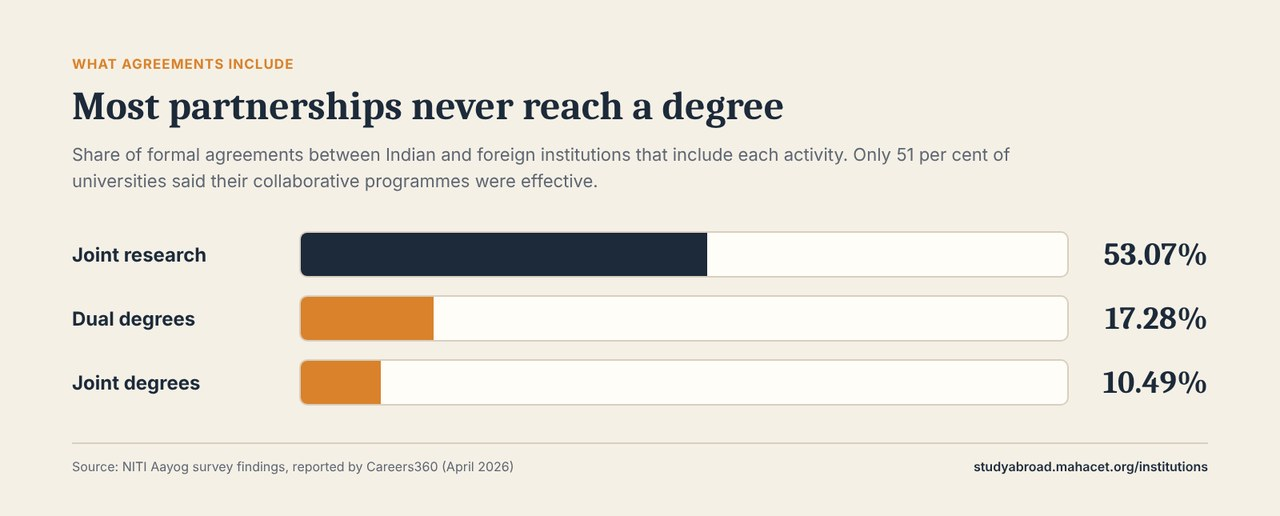
• Joint research: Included in 53.07 per cent of agreements.
• Dual degrees: Mentioned in 17.28 per cent.
• Joint degrees: Planned in 10.49 per cent.
• Effectiveness: Only 51 per cent of universities reported that their collaborative academic programmes had been successful and effective.
The gains that were reported were real but modest: 26 per cent of universities saw more students taking part in exchanges, 15 per cent saw more faculty engagement, and around 8 per cent reported better placements.
What a Working Partnership Looks Like
The University of Mumbai's relationship with the University of Technology of Troyes (UTT) in France shows how partnerships often grow in practice.
It began informally. A faculty member with a contact at UTT encouraged a master's student at the University of Mumbai's National Centre for Nanosciences and Nanotechnology to apply to a UTT programme. He was selected on a full scholarship and later moved on to a PhD in France. That first placement led to a small but steady flow of students from the centre and from Mumbai's Wilson College to UTT, which funds most of them.
By 2026, the University of Mumbai had sent about a dozen students to UTT for master's and doctoral study, signed a formal memorandum of understanding, and begun joint research, including work on a microfluidic device for detecting cancer. The two universities, with French diplomats, are exploring joint degrees. A professor at the centre noted that, as a state university, funding is limited, and that trust takes time to build.

Why Partnerships Stall
Practitioners interviewed by Careers360 identified recurring problems:
• Signing without a plan: Memoranda signed for publicity, with no defined outcomes, are often shelved.
• Unclear expectations: Without agreed objectives and timelines, neither side knows what success looks like.
• Pricing conflicts: One Indian university's 2+2 partnership with a US university collapsed when the US partner quoted it a higher tuition fee than it had agreed with outside consultants.
• Funding gaps: Students cannot take up mobility places without scholarships, and state universities have limited funds.
How to Build One That Lasts
1. Start with people, not paperwork: Faculty and research links are the most reliable foundation.
2. Pilot small mobility schemes: Short exchanges and individual placements build trust and show how students perform.
3. Map curricula early: Credit mapping decides whether twinning, joint or dual degrees are feasible, and avoids double-counting.
4. Agree fees and funding openly: Set tuition and scholarship terms in writing, consistent with what you charge other channels.
5. Confirm eligibility and the awarding body: Check NAAC, NIRF or ranking status at the start, and partner with the degree-awarding university.
6. Set time-bound outcomes: Define what the partnership should achieve in two and five years, and review it.
7. Widen access: Visiting faculty and collaborative online modules extend benefits to students who cannot travel.
Experts estimate that moving from first contact to a long-term programme typically takes two to three years.
What This Means for Government Officials
The regulatory barriers have largely been removed. What limits outcomes now is capacity: funding for student mobility, staff time for curriculum mapping, and support for state universities that lack dedicated international offices. Other states have tried targeted support, such as Karnataka's 2023 linkage of four public universities with the Pennsylvania State System of Higher Education and Kerala's Scholar Connect platform.
What We Do Not Know Yet
There is no public register of twinning, joint and dual degree programmes running in Maharashtra, and enrolment and completion data are rarely published. The NITI Aayog survey describes national patterns rather than Maharashtra specifically. Institutions considering a partnership should ask prospective partners for evidence of existing programmes and student outcomes.
A Note on Planning
Twinning, joint and dual degrees let foreign institutions build lasting academic links with Maharashtra without opening a campus. The law now allows it; the work lies in choosing the right partner, starting small, mapping curricula and agreeing terms openly. Partnerships built that way are far more likely to reach a degree than those that begin with a signing ceremony.
Students can explore destinations on the country comparison, browse fields under programs, and follow policy changes on Maha Study Abroad news. What this portal does and does not undertake is set out in its Honesty Promise.
How this guide was made: Information comes from the UGC's 2022 regulations as summarised by the Australian Government Department of Education and legal analyses, NITI Aayog survey findings and practitioner interviews reported by Careers360, and reporting by Free Press Journal and others. Survey figures describe national patterns, which we note. This guide is reviewed as the UGC updates its regulations.
Official Sources
Every figure in this article traces to the sources below. Rules and statistics change, so open the source before acting on it.
Government and regulator sources
• Australian Government Department of Education, Note on UGC regulations on academic collaboration between Indian and foreign higher educational institutions https://www.education.gov.au/download/13895/note-ugc-regulations-academic-collaboration-between-indian-and-foreign-higher-educational/27524/note-ugc-regulations-academic-collaboration-between-indian-and-foreign-higher-educational/pdf
Supporting sources (non-government)
• Careers360, Dual degrees, faculty exchange: states bet on foreign university tie-ups, but fine print tells another story (April 2026) https://news.careers360.com/state-university-foreign-dual-joint-degree-mumbai-mu-tie-up-ugc-rules-nep-dayanand-sagar-leeds-beckett-faculty-exchange-niti-aayog
• Careers360, UGC makes collaboration with foreign universities easy; allows three types of programmes https://news.careers360.com/ugc-dual-degree-joint-twinning-programme-foreign-university-nirf-naac-the-qs-ranking-regulations-chairman/amp
• Nishith Desai Associates, UGC's academic collaboration regulations are here https://www.nishithdesai.com/research-and-articles/hotline/education-sector-hotline/ugcs-academic-collaboration-regulations-are-here-5580
• Free Press Journal, UGC puts down regulations for foreign twinning, dual and joint degrees https://www.freepressjournal.in/amp/education/ugc-puts-down-regulations-for-foreign-twinning-dual-and-joint-degrees
• IASbaba, Academic collaboration between Indian and foreign universities https://iasbaba.com/2022/04/academic-collaboration-between-indian-and-foreign-universities/
Frequently Asked Questions
Do Indian universities need UGC approval for these programmes?
No prior approval is needed when both partners meet the eligibility criteria. The Indian institution informs the UGC of the collaboration.
Who awards the degree in a twinning programme?
The Indian institution. Students complete part of the programme, up to 30 per cent of credits, at the foreign partner.
How does a dual degree differ from a joint degree?
A dual degree leads to two separate degrees, one from each institution, in the same discipline and level. A joint degree leads to a single degree from a jointly designed curriculum.
Can a Maharashtra college partner directly with a foreign university?
Only with the approval of its parent university. Because affiliated colleges do not award degrees, the university is the essential partner for any degree programme.
Can these programmes be delivered online?
No. All three models must be taught in conventional, face-to-face mode.
How long does it take to build a degree partnership?
Practitioners estimate two to three years from first contact to a long-term programme, typically moving from faculty links and small exchanges to curriculum mapping and then a degree.